
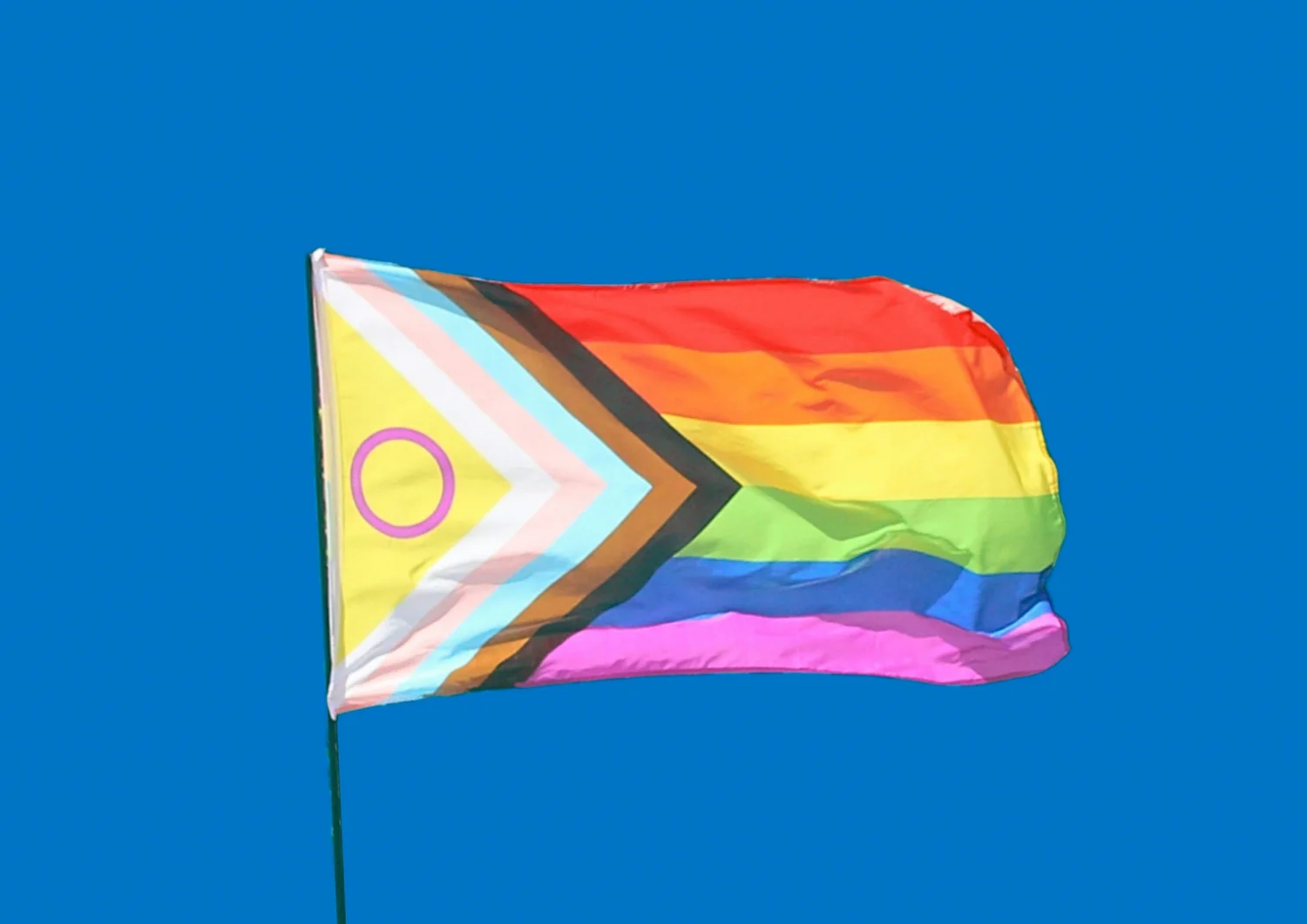
Pride Month is coming, and a lot of us are tired.
Tired in a way that doesn't always have a single source — tired from the news cycle, from the legislative fights, from the language being argued over in places that used to feel settled, from the quieter erosions, from watching incidents pile up in the GLAAD tracker, from the slow grind of having your existence treated as a debate topic by people who don't have to live the consequences. Tired from the personal stuff layered on top of all that: the family text thread, the workplace pronouns conversation that didn't go well, the friend who said the wrong thing, the partner you're worried about.
And now June is here, and the rainbow merchandise is on the endcaps at Kohl’s (bye, Target), and the parade dates are firming up, and your social feed is starting to ask you to feel something celebratory.
If that's landing as complicated for you this year — if the prospect of Pride is bringing up some mixture of fear, anger, grief, exhaustion, longing, and that strange flat feeling that's none of those — you're not alone. You're having a coherent response to a complicated moment. And the work of moving through this coming month well isn't about forcing yourself to be joyful. It's about taking care of yourself, in your particular body and your particular life, with the energy you actually have.
This is the first in a short series of Pride Month posts I'm publishing this year. We'll get into specific topics — family of origin, late coming out, religious trauma, what to do with the feelings that surface — in the weeks ahead. This one is the orientation. It's about how to enter the month from a place of self-awareness rather than autopilot.
Pride Was Always a Protest
It's easy to forget — especially under the layer of corporate Pride that's accumulated over the past two decades — that the first Pride wasn't a parade. It was a riot. The Stonewall uprising began in June 1969 when a community that had been raided and harassed for years finally refused to be quiet about it. Pride started as protest, as resistance, as a refusal to be defined and legislated by people who didn't want you to exist in public.
That history matters this June. Because the political climate has shifted. Anti-LGBTQ+ hate incidents are at record highs, with a documented increase of nearly 400% from June 2022 to June 2025, and more than half of those incidents specifically targeting transgender and gender non-conforming people. California, where many of you reading this live, logged more anti-LGBTQ+ incidents than any other state in 2025, with a particularly notable increase in the Los Angeles area.
I'm not telling you this to scare you. You already know. You've been living it. I'm naming it because the first piece of real self-care is letting yourself acknowledge what's actually going on, rather than gaslighting yourself into thinking your nervous system is overreacting. It's not overreacting. The threat environment has changed, and your body has been keeping track even when your conscious mind has been trying not to.
And yet — Pride continues, in part because of all of that. The original spirit of Pride is built for moments like this one. Whether you attend a parade, march in a smaller community event, support quietly from home, or step back entirely this year, you are not betraying anything. You are doing what your particular life needs you to do.
What Self-Care Actually Means (and What It Doesn't)
The phrase self-care has been so thoroughly absorbed by the wellness industry that it's almost lost its meaning. Real self-care for LGBTQ+ people in June 2026 is not a face mask and a bath. It's a set of grounded decisions about where to put your energy, what to expose yourself to, who to be around, and how to listen to your body when it tells you what it needs.
It's also not a single answer. Self-care for the friend going to West Hollywood Pride looks different than self-care for the trans person who's decided big crowds aren't worth the risk this year, which looks different from self-care for the person who's recently out and trying to figure out where they fit. None of these is the right choice. They're all available, and the question is which one matches your life.
A few principles that translate across situations.
Listen to Your Body Before You Make Plans
Before you commit to a parade, a party, a family gathering, or even a low-key brunch, take a minute and check in with your body. Not your social media plans, not your sense of obligation — your body. Where is your energy actually at? Are you running on fumes? Are you genuinely excited? Are you neutral? Are you dreading it but doing it because you feel like you should?
You're allowed to use your body as data. If the answer is I'm exhausted and the thought of being around a crowd makes me want to cry, that's information. You can still go, if you decide it's worth it. But notice that the decision is yours to make from a place of awareness rather than autopilot.
A useful frame: what version of myself will show up to this event, and is that the version I want to send? Sometimes the answer is yes, even when you're tired. Sometimes the answer is no, and the more loving choice is to opt out.
If You're Going to Pride Events
Some practical things, in case they're useful.
Plan your exit before you arrive. Know how you'll get out, where you'll go if it gets to be too much, and at what point you'll give yourself permission to leave. Having an exit plan paradoxically tends to make people stay longer, because the nervous system relaxes when it knows it isn't trapped.
Go with people who get it. The right companions matter more than the event itself. Someone who'll leave with you if you need to leave. Someone who won't pressure you to stay if your body has had enough.
Know what your body will need. Food, water, sunscreen, a charged phone, a meeting spot if you get separated. Boring logistics protect against bigger problems. Heat exhaustion and dehydration make every other stressor worse.
Stay aware without being hypervigilant. There's a difference between situational awareness — knowing your exits, noticing the crowd — and the kind of hypervigilance that exhausts your nervous system. The goal is the first one, not the second. If you find yourself in the second, that's a sign your body is telling you it's done.
Have a soft landing for after. The hours after a big event often hit harder than the event itself. Plan something gentle for that evening or the next day — a quiet meal with someone you love, time alone if alone is your soft landing, a low-effort show, sleep.
If You're Not Going
If you've decided this year isn't the year for parades, drag brunches, or big community gatherings — that's a complete answer. You don't owe anyone an explanation, and you don't owe the community your presence at any particular event to count as queer enough.
People sit Pride out for all kinds of reasons. Trans folks who've assessed the risk and made a different call than they made in 2022. Disabled queer people for whom heat and crowds aren't survivable. Parents whose kid isn't ready for that environment. People in early sobriety who don't want to be around the drinking. People in early transition. People in mourning. People who are introverts and have always done Pride differently. People who are simply tired.
A few things that might help if you're staying home:
Curate your feed. The algorithm doesn't know what you need. You can mute, unfollow, and step back from accounts that are making this month harder, including ones you generally like. The feed will be there in July.
Make a small, private version of Pride. Watch a documentary, reread something that mattered to you, look at old photos, spend an evening with someone who knew you before. Pride doesn't have to be public to count.
Let yourself off the hook. You are not less queer because you skipped a parade. You are not betraying the community by tending to yourself. The community, in its better moments, knows that sustainability is part of survival.
On the Anger
A lot of you are angry, and it's worth naming.
Angry that Pride has been so thoroughly absorbed by corporate branding that you can buy rainbow-themed everything at a chain store whose corporate political donations directly fund anti-LGBTQ+ legislation. Angry that companies who post pride graphics in June won't post a thing in October when it would actually cost them something. Angry that "celebration" has been packaged and sold back to you while the underlying conditions of your life have gotten harder. Angry that you're being asked to feel grateful for limited corporate inclusion while real rights are being argued away.
This anger is not a problem to manage. It's an accurate read of the situation. The work isn't to make the anger go away — it's to channel it somewhere that serves you. Rage at a target you can't reach is exhausting. Rage that you can put into something — supporting local LGBTQ+ organizations, voting, mutual aid, showing up for someone in your community who is having a harder time than you, being honest in conversations where it costs you something — tends to settle differently in the body.
You're allowed to feel the full thing. And you're allowed to decide what to do with it.
When Self-Care Isn't Enough
There's a limit to what self-care can do, and it's worth being honest about that. If you're navigating Pride Month while also carrying unprocessed trauma — family rejection, religious trauma, prior assault, the weight of years spent unable to be yourself, the cumulative effect of living under chronic political threat — the smartest self-care strategy can only go so far. The deeper material needs deeper work.
This is the work I do. My practice, Thomas Blake Therapy, is located at 210 S Orange Grove Blvd in Pasadena, with virtual sessions available throughout California. I specialize in EMDR therapy — a research-supported approach for processing the traumatic experiences that get stuck in the body and surface during emotionally charged months like June. I work with LGBTQ+ clients across the greater Los Angeles area, including South Pasadena, San Marino, Eagle Rock, Highland Park, Glendale, Burbank, Silver Lake, and Atwater Village.
If this June is asking more of you than you have, you don't have to keep moving through it alone. Reaching out doesn't commit you to anything. It just opens a conversation.
A Few Things People Wonder
Is it normal to feel anxious about Pride this year?
Yes. The political climate has shifted, anti-LGBTQ+ incidents are at record highs, and your nervous system is responding to real information. Anxiety in this context isn't pathological — it's accurate. The question isn't how to make it disappear; it's how to take care of yourself while it's present.
I want to attend a Pride event but I'm scared. What should I do?
Both can be true. Make the decision from a place of awareness rather than pressure in either direction. Plan well, go with people you trust, know your exits, and give yourself full permission to leave if you need to. Going scared and staying for an hour is a complete experience.
Is it okay to not feel proud during Pride Month?
Yes. Pride is shorthand for a complicated set of experiences, and many LGBTQ+ people feel grief, anger, exhaustion, ambivalence, or fear right alongside whatever joy is available. The month does not require you to perform a single emotion.
How can therapy help me get through June?
For many LGBTQ+ clients, the work isn't about Pride Month specifically — it's about the underlying material that surfaces in June. Trauma-focused therapy like EMDR can address family rejection, religious trauma, internalized shame, prior victimization, and the cumulative weight of identity-related stress. The result isn't usually that Pride becomes easy — it's that you stop being hijacked by what comes up.
---
Affirming Therapy for LGBTQ+ Clients in Pasadena and Los Angeles
Thomas Blake Therapy offers EMDR therapy for LGBTQ+ clients in Pasadena and across the greater Los Angeles area — for the family-of-origin wounds, religious trauma, and accumulated stress that often surface during Pride Month. Book a free 15-minute consultation today.